
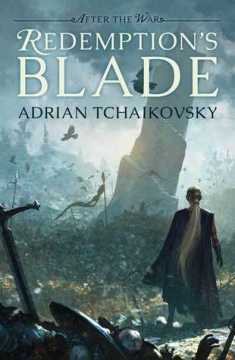
Published: July 31, 2018
Publisher: Solaris
Genre: Fantasy
Series: After the War #1
Pages: 367 (Paperback)
My Rating: 4.0/5.0
A copy of this book was provided by the publisher in exchange for an honest review.
Synopsis:
Ten years ago, the renegade demigod known as the Kinslayer returned. His armies of monsters issued from the pits of the earth, spearheaded by his brutal Yorughan soldiers. He won every battle, leaving burnt earth and corruption behind. Thrones toppled and cities fell as he drove all before him. And then he died. A handful of lucky heroes and some traitors amongst his own, and the great Kinslayer was no more.
Celestaine was one such hero and now she has tasked herself to correct the worst excesses of the Kinslayer and bring light back to her torn-up world. With two Yorughan companions she faces fanatics, war criminals and the monsters and minions the Kinslayer left behind as the fragile alliances of the war break down into feuding, greed and mistrust.
The Kinslayer may be gone, but he cast a long shadow she may never truly escape.
I’ve been kind of on a Tchaikovsky kick this year and after loving two of his very different books, I knew that Redemption’s Blade was definitely one I needed to check out. This is another books that is very different plot-wise from both Guns of the Dawn and Children of Time, however it does share a similar theme or concept. Tchaikovsky seems to enjoy looking at consequences or the after effects of a significant point of change. He does this to some degree in Guns of the Dawn when our battered war heroes return home and in Children of Time when he illustrates the after effects of both destroying Earth and unleashing a virus that speeds up evolution on a planet full of spiders. I suppose you could say that all books do this inspection of the consequences to some degree, but Redemption’s Blade goes to the next step.
Redemption’s Blade skips the entire part of the story that most fantasy authors would choose to write about – the rise and fall of a great evil and the heroes that slew him. Tchaikovsky instead chooses to gloss over that portion and throw us straight into the aftermath that many authors tend to stop at. Here we are introduced to Celestaine, or Celeste for short, who is one of the great heroes that slew the one known as the Kinslayer, enslaver of nations and species and destroyer of culture. He seems like a properly evil villain who was ultimately stopped and, while that would have made a perfectly suitable and even very exciting story, the lens on the time after that is actually much more interesting.
Celeste is feeling somewhat lost and inadequate after her great accomplishment and she and two Yorughan companions (formerly Kinslayer minions) sort of end up finding a new goal. There was a particular race of winged people that the Kinslayer subjugated and when they were taken their wings were torn off, essentially destroying a major part of their identity. Celeste sets out to restore their wings so that their young may be taught to fly by their elders and in order to do so she has to find some powerful magical objects. She and her Yorughan companions travel to several different cities, engage in hostilities of varying severity, and generally give the reader a decent tour of the world and provide a great many insights.
In all honesty, the overall plot is fairly slow and it took me awhile to appreciate Celestaine, though I enjoyed the appearances of the two artifact collectors who dog her trail from the very start. They reminded my somewhat absurdly of Bauchelain and Korbal Broach from Erikson’s Malazan world. I think what the true heart of this book is is the exploration of the aftermath. For example, in one city the priesthood is left rife with holes where leading members were killed or disappeared and those who were novices are stepping up to take on those roles, but perhaps with their enthusiasm misplaced. They try to kill the Yorughan with Celeste because they used to be the enemy. In another case, it’s mentioned that the Yorughan are working out a system to prove their value beyond that of the battlefield by going to help repair cities and rebuild infrastructure. There is a plethora of examples like these and I can’t even begin to go into them all.
Redemption’s Blade is a story that didn’t quite blow me away, but I felt it was well written and fairly entertaining while managing to impart some food for thought. I actually pondered this book for a few days after finishing it which is honestly very rare for me. If you’ve enjoyed any of Tchaikovsky’s other books I would recommend giving this one a shot, though bear in mind that though it does have action and events proceed at a fairly steady pace, it doesn’t read as if that’s its sole purpose. The second book set in this world is scheduled for release on September 4, 2018 and interestingly enough, it’s written by a different author. I don’t know what to make of that at this point, but I’m kind of interested in seeing how that book plays out as well.


Huh, a second author for the second book. Do you know who it is? I tried quickly searching on Amazon but found nothing but WWI books…
LikeLiked by 1 person
Justina Robson, who I’ve never heard of.
LikeLiked by 1 person
Thanks.
LikeLike