
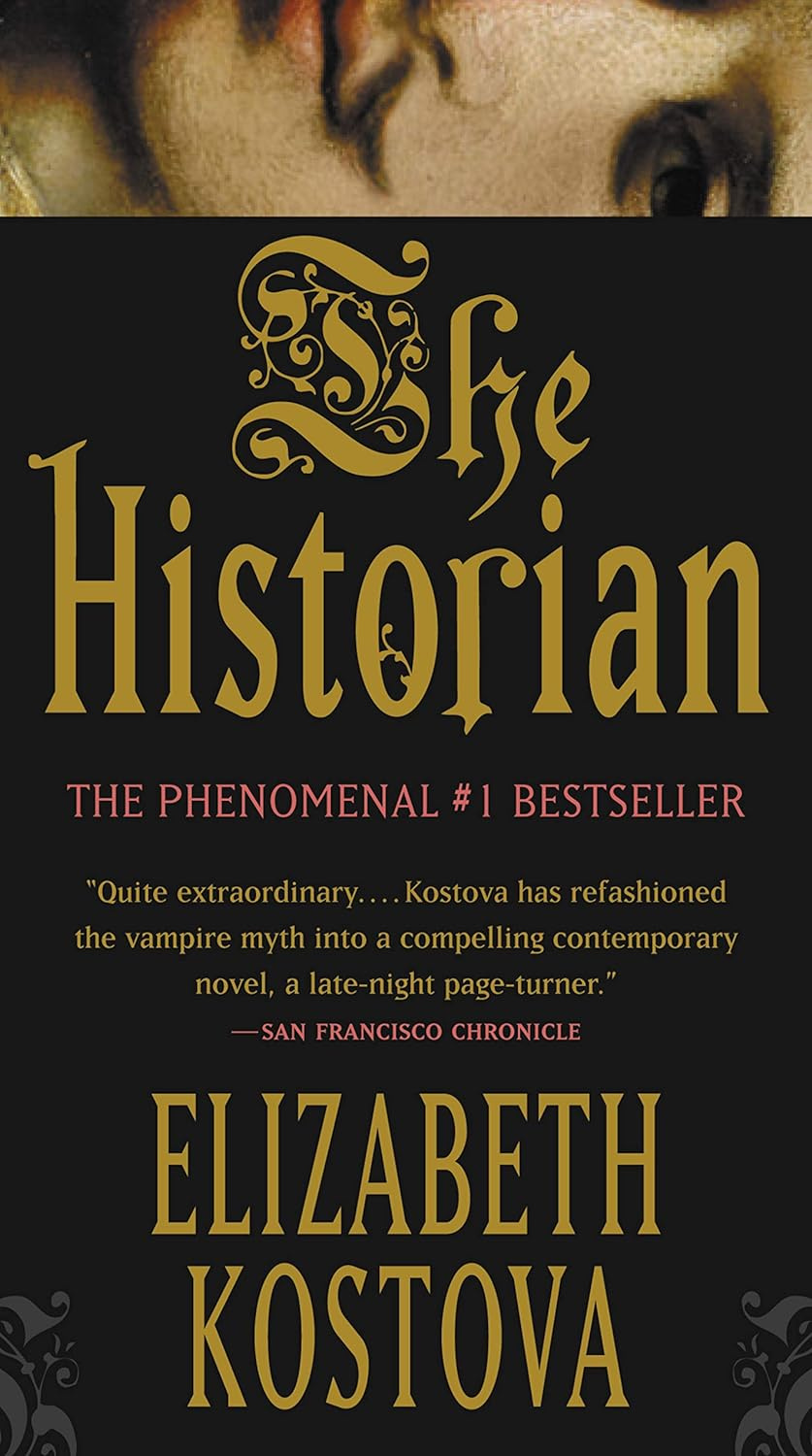
Published: June 14, 2005
Publisher: Little, Brown and Company
Series: N/A
Genre: Historical Fiction
Pages: 704 (Kindle)
Synopsis:
To you, perceptive reader, I bequeath my history….
Late one night, exploring her father’s library, a young woman finds an ancient book and a cache of yellowing letters. The letters are all addressed to “My dear and unfortunate successor,” and they plunge her into a world she never dreamed of, a labyrinth where the secrets of her father’s past and her mother’s mysterious fate connect to an inconceivable evil hidden in the depths of history.
The letters provide links to one of the darkest powers that humanity has ever known and to a centuries-long quest to find the source of that darkness and wipe it out. It is a quest for the truth about Vlad the Impaler, the medieval ruler whose barbarous reign formed the basis of the legend of Dracula. Generations of historians have risked their reputations, their sanity, and even their lives to learn the truth about Vlad the Impaler and Dracula. Now one young woman must decide whether to take up this quest herself–to follow her father in a hunt that nearly brought him to ruin years ago, when he was a vibrant young scholar and her mother was still alive. What does the legend of Vlad the Impaler have to do with the modern world? Is it possible that the Dracula of myth truly existed and that he has lived on, century after century, pursuing his own unknowable ends? The answers to these questions cross time and borders, as first the father and then the daughter search for clues, from dusty Ivy League libraries to Istanbul, Budapest, and the depths of Eastern Europe. In city after city, in monasteries and archives, in letters and in secret conversations, the horrible truth emerges about Vlad the Impaler’s dark reign and about a time-defying pact that may have kept his awful work alive down through the ages.
I’ve had this on my TBR for a few years now, specifically since the year I decided I wanted to pick up a bunch of popular dark academia books I hadn’t read. This one really intrigued me, largely because I hadn’t really heard of it AND it was about Dracula. Or more specifically, a historian researching the legend of Dracula and finding out whether or not it was real.
The Historian took me probably two weeks to read. It’s a chunky book, but the story itself is sometimes a bit thick to wade through and also a bit heavy at times. The timeline is also somewhat more complex than I typically encounter, with it being split between two timelines and being told both firsthand and via letters and stories told by the main character’s father and others. It begins when our main character is a fairly young schoolgirl and she begins traveling with her father, Paul, on diplomatic trips. As they explore all these different places throughout Europe, he slowly begins to tell her of his past and then eventually of her mother, Helen. Her father was a promising graduate student when he discovered a journal with the symbol of Vlad Tepes printed inside. This, along with the disappearance of his advisor, sets her father on a years long search for Vlad Tepes, also known as Dracula. He hopes that by finding his final resting place, he may also find his dear professor who was disappeared by this ancient evil’s minions. The story carries on, slowly unfolding more of Paul’s travails in this regard, while also following his teenage daughter who is searching for her now missing father.
Though this took me ages to read, I did end up quite enjoying the experience. It’s scenic and I loved all the descriptions of places and foods as well as the various people Paul and Helen encounter during their travels. Its also surprisingly foreboding, knowing that these minions are constantly tracking them and hoping to stymie their research in any way possible. People get bit, people die, suspicious things happen. Though it has fantastical elements, this is more of a historical fiction with a heavy focus on the historical. If you aren’t keen on this, I would say you may not enjoy this book all that much.
I found myself firmly on the side of enjoying this book, though I doubt I find myself ever re-reading it. There were parts that felt a little slow, which is something as overall this is a more sedately paced book. It was well written and the various timelines and points of view were all woven together nigh seamlessly. The Historian also fits well into the dark academia sub-genre and was a perfect pick for the fall season. I like a moody book that makes me feel like I learned something from it and this definitely led me into some interesting research rabbit-holes.


Leave a Reply